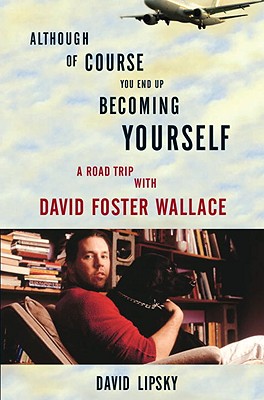
In 2010, there’re a couple of David Foster Wallace biographies due — I’m not sure when the other one is coming out, but David Lipsky‘s Although Of Course You End Up Becoming Yourself is the first one to be released, though, really, it’s not actually a biography. It’s a book-length interview conducted at the end of the Infinite Jest promotional tour. David Lipsky was hired by Rolling Stone to do an article on Wallace (or, perhaps more accurately, the hype around Infinite Jest) and so they sent him out to spend five days with the author. Unfortunately, the article ended up being spiked, but Lipsky kept all the tapes — and this is the result.
As Wallace is one of my favorite authors, I welcome anything more from him — his suicide in 2008 was an absolute tragedy, that someone so talented had to have such a short life; in a way, the interview format is better than a straight biography, in that there’s more of his actual voice. Of course, as it’s extemporaneous, it’s not as dense and as well-crafted as his work — but it’s clear that Wallace isn’t a put-on; he still has a simlar voice, albeit with much less in the way of digressions and 2 dollar words.
The book picks up steam as Wallace becomes more comfortable with Lipsky after they’ve spent a couple days together. At that point it becomes a bit more like they’re just having a conversation rather than an actual interview — though Wallace is always aware that it is for an article, and makes reference to the future piece and parts that he hopes will have the proper context, rather than just dropping a quote in that might sound strange divorced from the surrounding information.
The other great thing about when the book hits this point is that Lipsky’s parenthetical comments tend to fall down in number. The early chapters are filled with loads of, quite frankly, irritating notes of Lipsky trying to second-guess Wallace’s motivations for saying particular things. Lipsky’s favorite descriptor seems to be that Wallace was “flirting” with the interviewer, presumably in Lipsky’s eyes to make it so that he, i.e. Lipsky, will be more inclined to write his article more favorably. I admit part of my objection is that it tarnishes my mind’s-eye of David Foster Wallace as Pure and basically on the up-and-up and not nearly as manipulative as Lipsky seems to make him out to be. But most of my objection involves invoking the Dan Le Sac rule: Some people are just nice.
While the book definitely suffers from Lipsky’s desire to shove himself into the narrative by making comments after the fact (and that his introduction has a vaguely snotty tone I can’t quite put my finger on — and the really, really, ugly, awkward bit where his Rolling Stone editor gets Lipsky to pump Wallace for an admission of rumored — and non-existent — heroin abuse), the book is a must read for Wallace-fans. Not only is there insight into his life and history, but a lot of it feels like being in Wallace’s head-space, much like his fiction allowed us to feel. Although Of Course You End Up Becoming Yourself isn’t a perfect book — and I think could have been much better with a different writer leading the interview — it’s an essential addition to the DFW bookshelf.
Cookie Consent
We use cookies to improve your experience on our site. By using our site, you consent to cookies.
ID used to identify users for 24 hours after last activity
24 hours
_gat
Used to monitor number of Google Analytics server requests when using Google Tag Manager
1 minute
_ga
ID used to identify users
2 years
_gali
Used by Google Analytics to determine which links on a page are being clicked
30 seconds
_ga_
ID used to identify users
2 years
__utmz
Contains information about the traffic source or campaign that directed user to the website. The cookie is set when the GA.js javascript is loaded and updated when data is sent to the Google Anaytics server
6 months after last activity
__utmv
Contains custom information set by the web developer via the _setCustomVar method in Google Analytics. This cookie is updated every time new data is sent to the Google Analytics server.
2 years after last activity
__utmx
Used to determine whether a user is included in an A / B or Multivariate test.
18 months
__utmb
Used to distinguish new sessions and visits. This cookie is set when the GA.js javascript library is loaded and there is no existing __utmb cookie. The cookie is updated every time data is sent to the Google Analytics server.
30 minutes after last activity
__utmc
Used only with old Urchin versions of Google Analytics and not with GA.js. Was used to distinguish between new sessions and visits at the end of a session.
End of session (browser)
__utma
ID used to identify users and sessions
2 years after last activity
__utmt
Used to monitor number of Google Analytics server requests
10 minutes
_gac_
Contains information related to marketing campaigns of the user. These are shared with Google AdWords / Google Ads when the Google Ads and Google Analytics accounts are linked together.

 In 2010, there’re a couple of David Foster Wallace biographies due — I’m not sure when the other one is coming out, but David Lipsky‘s Although Of Course You End Up Becoming Yourself is the first one to be released, though, really, it’s not actually a biography. It’s a book-length interview conducted at the end of the Infinite Jest promotional tour. David Lipsky was hired by Rolling Stone to do an article on Wallace (or, perhaps more accurately, the hype around Infinite Jest) and so they sent him out to spend five days with the author. Unfortunately, the article ended up being spiked, but Lipsky kept all the tapes — and this is the result.
![Reblog this post [with Zemanta]](http://img.zemanta.com/reblog_e.png?x-id=bb160dfc-c3e9-4551-9014-1d9a88e47a6c)