One Sunday night in February 2024, a man had just left my apartment.
It wasn’t any good.
He had come over. I spent a great deal of time ensuring he had a good time; he was uninterested in returning the favor. Instead, it seemed to be very important for him to get back to work. I closed the door, disappointed.
He had seemed different when we talked, but he wasn’t. Just another worthless man wondering if maybe a trans woman could do better for him than whoever else he was sweet-talking. But he had been better than most at convincing me he might be different.
It was good practice, I guess, for being a woman. So many women go for far too long without partners who think our pleasure matters. Or, if it matters, it matters as our emotions do. Minor, uninteresting things to be tended just enough to secure our compliance, and then ignored to the maximum extent possible.
I was feeling worthless, empty, and used, and my ex-fiance was out of town. At the time, we were still sharing an apartment, and although my transition had moved us into the former partner category for each other, we still trusted each other with emotional matters.
This fit the bill, and so I messaged him.
I expressed potent frustration that none of these boys ever asked me to go somewhere on a Tuesday night. It was never out to drinks or dancing, never a place where we might get coffee. It was always just a negotiation about whose bed he wanted to use me in.
My ex listened attentively, asking thoughtful questions, as I explored myself and how I felt. All my sexual encounters were just empty, unfulfilling. They left me feeling unable to engage with the fullness of who I am and who they are.
Finally, he asked a question that marked the moment when I would begin a small but momentous transition. Not from man to woman, but from the woman I already was to the woman I was to become.
“Do you think you might be demisexual?”
And I remember reacting, internally, with such clear and unmediated passion – “No!”
All my body and blood and brain, all my heart and soul and mind, kicked that “No!” up and out of me in a flood.
I dug up the text I sent that night, to remember the immediate viscerality of my response. The exact quotation: “Oh my gosh I feel very strongly about this. No!”
Exclamation mark and all.
In hindsight, it was one of many things about me he was actually right about. He was always right about me. When I came to him in October 2022, saying I wanted to go “in drag” for a friend’s birthday party, he gave me a glance, said he would help, and told me years later that this was the moment he knew I was trans. He always had a way of seeing me and asking what I needed when I needed it.
And yet even with him, even with a strong emotional connection, I could never achieve sexual fulfillment. The closest we ever got was one day in the summer of 2022, June or July, just before my world cracked open. I had lost a great deal of weight in the years prior, fighting mightily to correct issues I was having with back pain and energy, and I had finally slimmed down into some of the brands of larger men’s shorts that were also larger gay men’s shorts, and had the short inseam to prove it.
And lying on the couch that day reading, showing more leg than my clothing had ever allowed me to show in my life, and feeling about my legs a way I had never felt before, a way a woman often feels when she is able to be happy about her body, he approached me. I was still, at that time, male-bodied enough to be attractive to him, and in the as-yet-unspoken and mostly-unheard corners of my mind, female enough to be receptive to these advances.
I melted into him, and let him melt into me. For a moment I felt something of what it must feel to be connected, not only to another person, but more deeply to myself. I didn’t let myself connect to her very often.
That may have been the day my egg cracked, to use the common parlance of transgender people trying to find words to express these moments that fill our lives with glory, and yet are so foreign to the cisgender majority.
But even then, it wasn’t fully open. I only tasted a small glimpse of what it would be like to engage another human being intimately in the fullness of my body.
Because even in that encounter, there still lurked around the edges a missing piece, a moment of union and connection that I could not find. Something that couldn’t be touched; openness I couldn’t risk, because to open it to him would mean opening it to myself.
This is what dysphoria is for so many of us; not a glaring signpost, not a flashing demand inside of our hearts that we must be a woman in man’s body, but just a quiet, lurking disquiet, an inability to connect with others not because we aren’t deeply in love with them, but because we are refusing to connect to the pieces of ourselves that will enable us to live authentically with another person.
On that February night, I reacted strongly out of a misunderstanding about what demisexual meant; it actually means someone who develops sexual feelings for someone only after a period of getting to know them, of building a connection. At the time, I thought it simply meant something more like “half-sexual,” some sort of midway point between strong sexual appetites and asexuality.
And I felt very sexual. Outrageously sexual. Scandalously so; an incandescent bonfire of desire and passion and needs that I could not name or reach. But mine was the glowing fluorescence of a kerosene lamp: warming, but if a cow kicked me over I might burn down Chicago.
The capaciousness, the depth of my sexual desire, felt dangerous to me.
But even as I said it, beneath all of that sexual tension and force and desire and need, I suddenly understood what the danger was, what it was I was avoiding.
It was grief, and the fear of what acknowledging that grief would mean.
In that moment, on a Sunday night in Chicago, talking to my ex and listening to Morten Lauridsen’s Chansons des Roses, a truth struck me like the bolts of lightning that flash across the lake sometimes on clear nights in the wintertime.
I had been avoiding sex because I knew I couldn’t feel it the way I needed to. I couldn’t accept it for myself, I couldn’t relax into it, I couldn’t feel my body in it, I couldn’t name what I desired, because I had decided what I needed was just too hard to get. All the parts and the pieces were just wrong.
I was living in a half sexual way because I had no way to be myself; even when I was engaged in sex, it was half sexual. Part of me was missing, replaced by a part of me that “worked okay.” It didn’t seem to be causing me distress on a day to day basis, but I realized that night it was one more example of how dysphoria didn’t have to be actively brutal to still be dysphoria.
I had interpreted that grief as an unnamed and unknowable source of danger because it posed a danger to me: the danger of change, the danger of risk, the danger of putting everything on the line in the hopes that it would work, that I wouldn’t regret it, that I could change myself and my heart so permanently that my happiness might become more important to me than anything else; that I might not only love my neighbor as myself, but myself as myself, too.
Why continue being half-able to live a sexual life when an authentic experience might be within reach?
The third of Lauridsen’s Chansons des Roses, “Of your dream too full,” had just begun playing. The words, taken from Rilke, seem too perfect to be a coincidence. They speak of a dreaming rose, wet with the mourning dew, so weighed down that it is unable to rise high. But still a gentle strength sleeps in the rose, a “tremulous longing.”
All that is needed is to wipe that moisture away as a good gardener does, or simply let the gentle warmth of the sun clear it away so that “tender shapes between cheeks and breasts” can rise to take their petaled forms.
And suddenly I knew what that ache was that I felt on certain nights. It had been slowly starting to grow between my legs like a blaze that had nowhere to go but up and out. Just between my thighs there was a bud folded in on itself. It was a flower desperately yearning to break open and breathe in the sun and the air. It wanted to welcome life into it so that life might come from it. I felt it more and more: an insistent, tingling demand that there was something inside me that had to be touched.
But it might be touched if I would but listen to the demands my heart, soul, and mind were placing upon me for authenticity and wholeness.
That was the night I knew I needed a pussy.
The realization came with a sudden, stark awareness of the challenges. Despite having lost weight, I still weighed significantly above the thresholds many surgeons apply for bottom surgery. It’s okay, in a fatphobic society, for other people to have access to informed consent, but it’s completely okay for fat people to have additional barriers to receiving medical care. And then we wonder why their health care outcomes aren’t good.
There were concerns about sensation; would I be able to enjoy sex after surgery? Would it solve the problem I needed to solve?
Of course, the recovery would be a concern; at the time, I knew nothing about it, how long it would take, if there would be a hospital stay, what I would need to know to prepare at work for an absence of who knew how long.
And would insurance pay for it? Could I afford it? Would I be able to secure the funds I needed for aftercare?
The list was long and daunting. It was a hard night; I was brought to tears as I realized the shape of what I needed, and the steps it would take to get there.
But when my heart finally outpaced my tears, I was left with a quiet, gentle clarity. I knew, somewhere inside of me, that the path ahead had just gotten harder in a practical sense, but easier in an emotional one.
Because knowing came first:
This is what you need to be made whole.
* * * * *
Here I am, writing these words a year to the day after my surgery.
I won’t bore you with the practicalities. There were doctor’s visits and interminable trips to the electrologist. There was the work of finding a surgeon for whom my weight wasn’t an issue – but who did tell me, frankly, that the outcomes would be less risky and the recovery easier if I could try to lose at least some weight before surgery.
It was a maze of executive-function traps. Insurance calls, careful planning, and more. For a year, nearly the entirety of my focus was on pulling together surgical resources. I was lucky beyond measure to find a surgeon whose waiting list was small.
What I do want to say is this:
I do not regret anything.
I cannot fathom how anyone can regret this surgery. It is not something you get on a whim, it is something that requires you to stare your life in the face and say that you see the shape of it whole and clear, and this is what you need to move forward.
I experienced a profound moment of glory when my bandages were removed. My brain had been ahead of my body for years, and under the surgeon’s care, my body had caught up.
But that catching up had happened under the influence of anesthesia. My body was the tortoise to my brain’s hare. While my brain was sleeping, my body crossed the finish line. I woke up with bandages on myself, only vaguely knowing where I was, feeling unfamiliar sensations. While those bandages were on, every drip or twinge was felt on anatomy that was no longer there. I knew it wasn’t there, but my mind just hadn’t caught up yet.
When the bandages were removed, I asked everyone to leave for a moment, and I took the hand mirror off my nightstand. I saw myself in it, and that first sight felt like the invisible tether holding my body and brain together, so long in tension in either direction, snapped at last. My body and brain snapped together.
The fourth Chansons des Roses by Lauridsen again came to mind, “The Perfect Rose.” “I have such awareness of your being, perfect rose,” the poem says. “…[M]y intellect mingles you with my heart in celebration.” At that moment, my rose perfected, I breathed it, and it breathed me: a perfect friend of such a friend.
People love to say that transgender people are somehow defying God’s design, refusing to honor the bodies God lovingly built for them. Those same people will then beg for God’s favor when their loved ones are in surgery, asking that God guide the surgeon’s hands and feet.
Transgender people are still being knit together by God every day. Just like we all are: clay in the hands of a potter. Built and broken, remolded and remade, always to a form that is perfectly suited for the work to which we are called.
With trans people, God just takes a little longer, placing us into a new womb: the womb of the world. That womb is just as fragile as our mother’s. It can withdraw its support at critical times, it can refuse to carry us to term. So many of us are aborted by people who claim to love the unborn, so many of us never see our rebirth because of the exact same people who insist we must be born again.
But if we are lucky, if the womb of our communities and our societies functions as it should, we can find the practiced care of medical professionals and surgical teams to complete the transformation God always intended for us and become the people God means us to be.
Looking at myself free of those bandages, I felt Her holding me, like a newborn learning for the first time what it meant to breathe.
At 39 years old, I was born again.
I was made whole.
* * * * *
Three months after surgery was shortly before Thanksgiving.
That was when I could have sex for the first time, medically speaking.
I had joked with friends: “I turn 18 in November, and the boys better watch out!”
But the truth was that surgery changed something inside me. Demisexuality was no longer something I ran from. It was me.
And I had learned that I was tender.
I’ve already shared my first lesson in tenderness. Those early days with bandages still on, struggling simply to get from bed to chair, unable to pee without the assistance of a catheter, watching my own blood drip into a suction drain, finding even small motions enormously taxing, I learned that I had to take new steps to protect myself, do new things if I wanted to heal.
I had been given a great gift, not one to be given away lightly.
The second lesson was not far behind. When my surgeon came to remove the packing from my new vaginal canal, she said, “You’ve probably seen this happen before in various surgery videos online.”
I had to stop her there. “Doctor,” I said, “I need you to understand that I’m your most normal patient.” A joke with myself; just a normal woman, straight, dreams of weddings and princesses and pretty pink ribbons in her hair. Just a normal woman, yessir, nothing to see here. Just a normal biological woman with a gland problem.
And she laughed. “Well,” she said, “some people find it a very peculiar sensation.”
And peculiar it was. Mostly it felt like nothing, but then suddenly, as a gossamer of gauze lifted away from the soft, fresh skin inside my new body, there was a brief but intense flash of pain like nothing I’ve ever felt before and never want to feel again.
Have you ever been tickled with a hammer? No? It’s like that.
And that was happening inside me; muscles that had never been touched were now being flexed, moved, exposed. Skin that had never touched the air was now breathing free, breathing free just like me.
And as good as that was to be complete, it was tender. I was tender. Wholeness requires tenderness; to be the full sweep of who you are, to feel the air on your skin, is to be exposed.
My next lesson would begin a day later, when she returned to teach me dilation, a process that would define my life for the next three months, like one long, unending classroom of self-discovery and exploration.
When she came into the room, I stopped her before she could say anything. “Doctor, before we start…”
“Yes, my dear?” That’s what she always said: “My dear.”
“I….you need to understand, I’m…very straight,” I said, maybe blushing a little.
(Me, blushing? Transition was complete, it seemed).
“This is the only vagina I have ever seen in person, outside of a textbook, or on a screen. I…can you show me what I’m looking at?”
She laughed, and I gave her my hand mirror, and as she gave me my own personal anatomy lesson, gently and carefully, since not much at the time could be touched or manipulated, I learned how my new body would start working for me.
“There’s not another other surgery like this,” my surgeon would say six weeks later, when I expressed through tears at a checkup the frustrations I was encountering with what seemed like slow healing and difficulty with the dilation protocol. “Other surgeries, we always say, ‘Keep it dry, don’t touch it.’ For this surgery, we say, ‘Take a hard silicone rod, coat it in lube, and rub it all over the healing zone for at least twenty minutes.’”
It took much longer than twenty minutes, though. Twenty minutes start when you get the final size you’re working on into your body at full depth. You start with a rod that’s easy, no more than half an inch wide. Over the course of months, you scale up gradually to much larger tools. Sometimes, though, if you’re working on a larger dilator, you have to start with the smaller one first. This gives the muscles time to relax, expand, and accommodate.
You eventually have to get the largest rod you are working on a full six inches inside your body, which can take anywhere from one to two hours, depending on how many smaller rods you need to use as you scale up. And only then does the timer start.
After that first dilation, I followed that schedule diligently, even when my body felt like it was breaking. I thought I would be back at work in a month. I was wrong. I tried, but had to relent after finding the sheer physical and mental toll too much to bear.
Three months of dilation will teach anyone what tenderness means.
I’m convinced that most doctors would prefer to have a longer term than three months for this initial period of intense dilation, too, but they know good and well that the Family and Medical Leave Act only allows for 3 months off work. As with everything in this country, health and wellness are second fiddle to serving the interests of capital.
I estimated the number of hours I’d spent in dilation after one year of work, and it came to 972. Out of 8,760 hours in a year, over 10% of my year had been spent on my back. I explored places inside of myself that were sometimes raw, often bleeding. Although locations of joy and hopefulness, they were also places where the greatest challenge was understanding my body. What does it need? To slow down or speed up, to move gently in and out, or from side to side? Each move was designed to help skin and tissues learn to relax, to accommodate.
Much the same, in fact, could be said of our emotional lives; exploring those requires just as much attention, care, hope, and bravery as anything I did with a dilator.
During those three months, my lessons in tenderness had combined to teach me much, but one thing in particular blazed like a beacon:
Sex can hurt.
I suddenly couldn’t imagine having sex with someone I hadn’t been on a date with; someone I hadn’t spent time with, enough time to learn how they reacted when I said no, enough time to gauge how they would listen if I said slow down; what they would do if I said, I’m sorry, I thought I was ready, but I’m not: my body won’t let me do this.
My initial outrage at the suggestion of demisexuality led to an embrace of it. I couldn’t do things casually anymore.
I needed trust, deep trust, if sex was going to happen for me.
Even at month three, dilation could still be painfully, precariously difficult. I had been joined a few times in bed by a partner, a lover I had met and grown close to shortly before surgery, and all we had been able to do (indeed, all I had been allowed to do by my surgical team) was lie in his arms and dilate with him holding me.
It was intimate, real, meaningful, but it was not sex.
It took so much patience. Much longer than sex, sometimes, and once we started, it was hard to stop; he was holding me for the duration, even if there were tears, even if there was frustration. He was kind to me, “You’re being very brave,” he would say, and he meant it.
And I still wasn’t ready, on November 22nd, to let him or anyone else in. I wasn’t sure when I would be ready. I took my time. My surgeon had told me, at a check-in around this time: “You can have sex now if you want, but go slow. Listen to your body. Decide when and what you need; be prepared to stop.”
And for a while, my body was telling me not to try at all.
Eventually, that sense faded. Eventually, I had done enough work with my dilator that I was ready to try; eventually, I had been held enough, touched enough, engaged enough, tended enough, that I was ready to say, carefully, to this kind man: I’d like to try. I’d like to try with you, if you’re willing.
And he was.
It took time; I dilated a little first to help make sure everything was nice, slick, and relaxed. And then, on my back in his bed, he wrapped his arms around me and pressed against me, and brought his lips to my body, to the part of me that was more new than anything else.
That first touch, nothing even inside me yet, brought tears to my eyes.
He stopped for a moment because the keen, piercing profundity of the experience brought more than gasps into my breath, but sobs. He came up alongside me and held me as the staggering grief of decades of lost connection and the extraordinarily potent joy of a heart-deep, soul-deep, mind-deep need suddenly fulfilled itself in me.
He held me close as the wracking gasps of a hope fulfilled after years of yearning broke over me. All my heart, mind, and soul were collectively streaming together to tell me yes. This is indeed the body for which you were made. You have come through to the other side.
The blossom in me, the bud that dysphoria and dysmorphia had buried between my legs and trapped, had been revealed. It was up to me to gently, carefully—tenderly—coax it open. I taught it to calm, let myself become the Rose I had named myself after. My petals were opening to pollination as I let myself embrace the sacred truths of who I was. I had surrendered to who I am meant to be.
It was like that moment when my body and my brain finally ran in sync together in the hospital bed. For a moment, my grief and my joy and my hopes all aligned. Every decade of my life spent not understanding the body I needed were washed clean. All the trauma and need and desperate desires I was unable to name or experience constellated at once. Suddenly, I was getting something I had always thought I wanted. I was getting it from someone I trusted to give it.
We both finished that night. Virginity is a complicated thing; I was not a virgin on that night, but in many important respects, I was. I opened for the first time. I learned the radical surrender my body needed to undergo to accept this partner into me. He had shown me I could trust him enough to care for me in this profound, precious time.
When I write, I am most often writing for Christians. I am most often published in Christian circles; my audiences are typically Christian. You will note that this is not being printed in those venues, perhaps for obvious reasons; it’s about a trans woman having surgery and then having sex with her neovagina.
There are not many places in Christian publishing ready to put something like this out there, under their masthead.
But here, here I can say what I want to say most directly to Christians everywhere, with as much bravery as I can summon:
Transition is a sacrament. Transgender people are bottomlessly, deeply, undeniably sacred. Transition-related medical care is one way in which we experience the outward, visible signs of inward, spiritual grace.
Irresistible grace.
I have repeatedly mentioned opening up to myself with all my heart, mind, and soul—an intentional choice, for the greatest commandment is to love the Lord my God with all my heart, mind, and soul. Or strength, as the scripture sometimes puts it, depending on who is translating.
I cannot do that—I cannot be that—no transgender person can, if they do not know their own heart, mind, and soul. To love the Lord your God with all of these things is not possible if you do not know them.
Granted: not every sexual encounter is healthy, productive, or even all that good. I’ve had a few since that night in December that were decidedly unremarkable, or even misguided. This is not a paean to embracing all sex as definitionally good. Sexual sin remains possible. Sex remains a place where we can distance ourselves from ourselves. It is a place where we can make mistakes, where we can disobey the demands of our bodies and the desires of God for our flourishing.
More of us should pay attention to what is happening in our lives when we have bad sex. What is going on with our hearts, souls, and minds? We would be more attentive to developing ourselves better for this delight. We would be able to receive it and attend more fully to who we have it with. We can embrace more directly how it can open us to glory and fullness.
Because while there are times when sex is wrong, there are also times when it isn’t. That night, it was a vessel of grace. There are times when getting fucked has a sacramental power, poured out from the hand of God Herself for the good of Her children. Those are the times when we come alive with the sacred. It verifiably pours out from our very skin.
We are so good at forgetting that every single person we encounter is a blazing sigil of the image of God alive and working salvation in this world every day. And we forget that this is true of ourselves, too.
One night in February, I was reminded of this truth I had forgotten.
Nearly a year and a half later, I experienced what it is to work, strive, suffer, and struggle through. I know what it takes to rebuild the parts of you that need the grace of connection.
And finally, after all that work, I experienced something so good, so profound, so meaningful, so holy, that I glimpsed a piece of what redemption might look like on this side of heaven.
The fifth movement of Lauridsen’s Chansons des Roses, “Dirait-on,” broke revelation open on me. “Abandon surrounded by abandon,” it opens. Abandonment of myself was what I needed that night to surround me. I had to surrender to my inner self and to my lover.
“Tenderness touching upon tenderness,” the poem says, and tenderness was exactly the process I had explored delicately, tenderness I had touched with prayers and tears for months upon months.
“It is your interior self that unceasingly caresses itself.” It says. Yes. I had worked with dilators and fingertips, but also with my mind, my heart, my soul, my strength, to caress myself into completion.
I had caressed myself for so long, my delicate Rose, and now it was open, able at last to be caressed by another. Finally ready.
Finally whole.
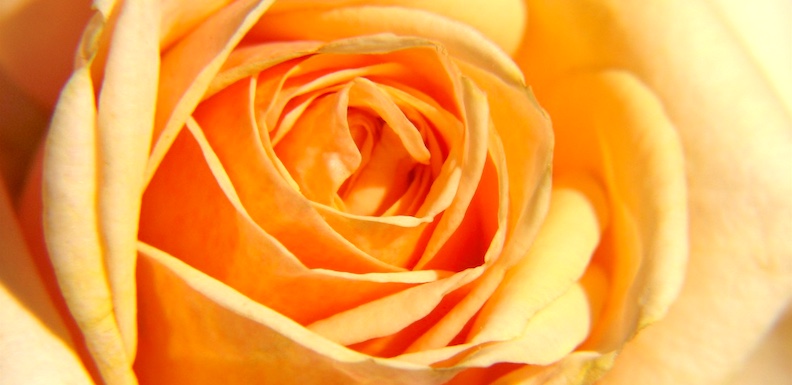
Featured image: “Peach Miniature Rose Interior” by Audrey, CC BY 2.0
Kittysneezes is supported by readers like you. If you enjoy what you’ve read here, please consider supporting us on Patreon or on Ko-Fi.