Kittysneezes is supported by readers like you. If you enjoy what you’ve read here, please consider supporting us on Patreon at http://patreon.kittysneezes.com.
Full disclosure: I have not paid to see Mercy and likely will not. It’s not even a matter of money being tight. It’s an Amazon original movie (blech) starring Chris Pratt (eghk) about a future where an AI judge has completely replaced the justice system. Chris Pratt plays a detective who may or may not have murdered his wife. According to the tenets of the titular program, he has 90 minutes to convince the AI judge he didn’t kill his wife (or to give the computer a 92% on the Reasonable Doubt meter he didn’t). He has access to all the glories of the panopticon: Ring cameras, people’s cell phone records, all the good stuff we agree isn’t actually being monitored.
I don’t think I need to convince you, with some middlebrow semiotics, that this is mostly about Amazon and its partnership with Ring cameras, that what is posited is a world that works a little too well and can be adjusted with a sudden injection of heroism. You have read a book. You know, for instance, that most of the military equipment in Hollywood films is on loan from the United States military. (If you don’t know, now you do). Examples abound. To me, it’s less interesting that Amazon made a movie about a panopticon future. They’re certainly doing their job of creating it. What does need to be discussed is science fiction, and why the oligarchs talk to us in science fiction. There is nothing stopping Amazon from creating a domestic thriller a la Cape Fear where Max Cady is stopped with the Ring camera or a fluffy romantic comedy where Ring cameras are used to facilitate a meet cute. But they have instead chosen to write about what would be the worst possible end of their technologies.
If you want to start a fight around a bunch of book people, a good strategy is to ask everyone to define science fiction. You will probably get a variety of answers, with a number of recurring themes. Technology, space flight, aliens, the future. What you find when you dig into science fiction work is something else. Is Star Wars science fiction, one might ask (this seemed to be one of Frederic Jameson’s more gnomic quests in life, even coming up in “Postmodernism: The Logic of Late Stage Capitalism”)? Well, we certainly don’t have lightsabers and blaster pistols but Star Wars also doesn’t care that much about these items; the thrust of Star Wars is the quest of Luke Skywalker to help overthrow the Empire, which is a story you could tell by giving him a claymore or an AK-47. There’s also the complication of In a long time ago in a galaxy far far away. I use Star Wars as an example because we all know what it is, and we think of it as science fiction, but a lot of this is way closer to what we might call fantasy. Other definitions try their damnedest to shoehorn an idea of progress. SF Encyclopedia’s article on the definitional issues of describing science fiction is enlightening in this regard. Early publishers like Hugo Gernsbeck and John W. Campbell defined the genre in a rather prescriptivist way: Gernsbeck describes the nascent genre as “ a charming romance intermingled with scientific fact and prophetic vision … Not only do these amazing tales make tremendously interesting reading – they are always instructive. They supply knowledge … in a very palatable form …” in Wonder Stories #1. Campbell’s later definition: “”Scientific methodology involves the proposition that a well-constructed theory will not only explain away known phenomena, but will also predict new and still undiscovered phenomena. Science fiction tries to do much the same – and write up, in story form, what the results look like when applied not only to machines, but to human society as well.”
Fair enough. One problem, then. JG Ballard was largely connected with the genre throughout his career. His most infamous novel, Crash, concerns itself with London suburb professionals who get turned on by car accidents. He did not put a flying car in the novel, or make anyone have a robot car baby like Titane, yet the novel remains science fiction. How? The novel does speculate the accident fetish will spread, but that is just as easily understood as the novel’s Dr. Ballard’s fetishistic view of the car accident becoming an operating principle with which he interfaces with the world. Scientifically, that’s known as “cum-brain”.
His own artistic goals for the genre were best encapsulated in his essay “Which Way To Inner Space?” Ballard sets up a problem in this essay: he both believes science fiction to be the only fiction equipped to deal with “tomorrow”, but also believes it is being outpaced by painting, music, and film. The telling portion is not so much in what he says science fiction does, but what these other mediums do: “these [the mediums laid out beforehand] have become wholeheartedly speculative, more and more concerned with new states of mind, new levels of awareness, constructing fresh symbols and languages where the old ones cease to be valid.” His bete-noire– at least in this essay– “space fiction”, the specialties of Gernsbeck and Campbell, has not only been outstripped by reality in its content but what influences it can have on the inner life of the character and more importantly, the reader. The essay is even predicated on the ending of the space fiction age with the moon landing. To exemplify what Ballard believes would be science fiction’s new mode, he writes of a story that he or someone else would have to write: a story about a man with amnesia on an island waking up next to a rusty bicycle wheel, “trying to work out the absolute essence of the relationship between them.”
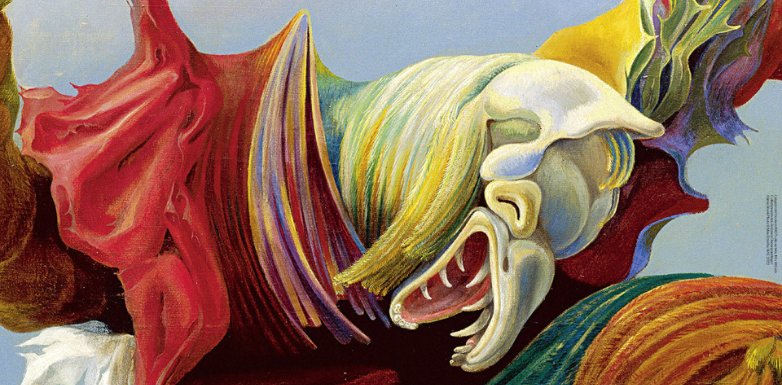
My biases are probably apparent here. I like New Wave sci fi. I’m not very interested in Golden Age sci-fi, though I’m sure that here and there there are exceptions, a Bradbury or Clarke at the bottom of the filing drawers where I store everything I’ve ever read. Ballard is but one practitioner of New Wave science fiction, but one I find instructive in this context. His hopes for the genre were for something ‘abstract’ and cool (we can find some comedy in Ballard’s idea that sci-fi will only work if science fiction authors become JG Ballard), something that uses “psycho-literary ideas” and resembles the invented worlds of abstract painting, like Max Ernst or other surrealists. But even in the purest evocation of JG Ballard’s newest science fiction, the amnesiac man and the rusted bicycle wheel, one thing remains: man’s relationship to technology.
For today’s purposes, I’d like to define science fiction as a literature of technology and humanity’s relationship to it, whether that technology is real or imagined being besides the point. The genres all have their drives that define what we are reading, and in science fiction, it’s the drive to understand how technology impacts people’s habits and personhood. Throughout the lifetime of science fiction, we have seen untold scientific advances in everyday life, all the way up to the home computer and the invention of the internet. But a key difference remains between the technology of yesterday and the technology of today, which is that much of the technology of today, such as generative AI, largely does not exist to advance anything besides the profit of people like Sam Altman or Elon Musk. Elon Musks’s robots, his space ventures, his yearn for Mars: they are not about humanity so much as they are an avenue for the richest man alive to prove his largesse to himself. These are not technologies that hearken towards wide adoption.
Mercy, in the hands of any other creative team, could have been about surveillance and how the other side of the thin blue line has not cared about the law and the effect it has on our main character, Detective Chris Raven. This film would have probably had no small amount of noir influence outside of “accused bad man did not do this crime”. But instead, there is the need to obfuscate that much of today’s technology will never reach the point of the infallible cyber judge. It exists to create the link in your mind that, actually, these are powerful technologies that transform society instead of a long running shell game between a series of tech firms. It’s here where the ghosts of Gernsbeck and Campbell come most in handy. If science fiction is a literature of “charming romance” that “predict[s] new and still undiscovered phenomenon”, then technology merely has to do what it does, and science fiction follows afoot. The old science fiction could be populated with paper-thin, two dimensional characters because it was obsessed with how many dimensions could access via a super computer. Hearkening back to these ‘simplistic’ days when technological advancement actually did solve some issues of existence allows them to convince you that this is what they are doing now.
It’s here where you can believe that ChatGPT, which mostly exists to agree with you, could one day handle the complexities of crime and punishment. It’s where you could believe that, one day, this will all feed into some grand singularity where we interact with each other on a third plane mediated by technology. The question of inner space does not need to be asked, because technology doesn’t exist for people to use it. It exists to use people to prove its omniscience, its power. This new technology needs science fiction to allow people to put themselves into a narrative where this isn’t the case, so that what they want can continue on, unabated. For all the new oligarch’s love of science fiction and fantasy, what they create resembles the most dominant genre on the internet more than any golden age text or Lord of the Rings. They’ve created an oblique pornography nobody can orgasm to, but themselves, alone.